Most catamaran & trimaran owners don't spend much time thinking about their trampoline nets until they're standing on it and is disappears from beneath them and
their leg (or worse, their entire body) falls through the net. At this point, they've experienced "catastrophic net failure", a multihull risk that is not discussed
enough as it is not just inconvenient - it can be highly dangerous.
It doesn't happen slowly. There's no gradual tear that gives you time to step back. When a UV degraded trampoline net fails, it
unzippers, and understanding why this happens is critical to understanding why some nets are safe and others are ticking time bombs.
How the Unzippering Effect Works
Here's the physics: every strand in your trampoline mesh shares the load when you step on it. When one strand breaks, its share of the load
doesn't disappear, it transfers instantly to the adjacent strands. On a healthy net, those neighboring strands absorb the extra force without issue.
But on a UV degraded net where every strand has lost significant tensile strength, the adjacent strands can't handle the sudden increase. They break.
Now even more load transfers to the next strands over, which are equally weakened. They break too.
This cascade accelerates. What starts as a single strand failure becomes a rapidly expanding hole in a fraction of a second, far faster than you can
shift your weight or grab for something solid. We've heard from customers who went from standing on their net to waist deep between the hulls before
they could react.
The dangerous part is that the degraded not may not look particularly damaged. They might often look a little old, but not necessarily in immediate
need of replacement. UV radiation breaks down polymer chains throughout the entire net uniformly, so its not like there’s an obvious weak spot to avoid.
The net appears functional right up until it catastrophically isn't. And this isn’t just an issue on old or inexpensive catamarans, we’ve seen catastrophic
failure on 3 year old Million dollar boats because the manufacturer used lower grade netting from the factory. In fact, the substantial majority of production
catamarans have this issue with their OEM nets.
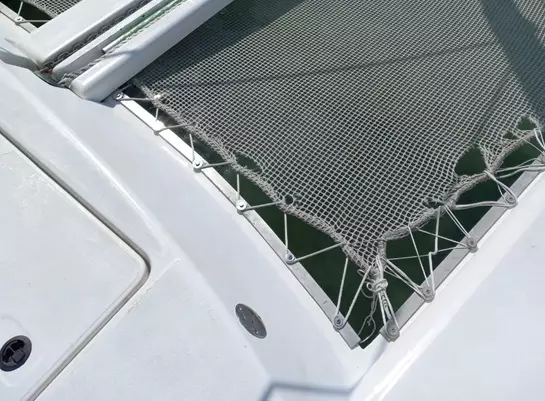
Example 2 year old nets
from a major aftermarket
net competitor
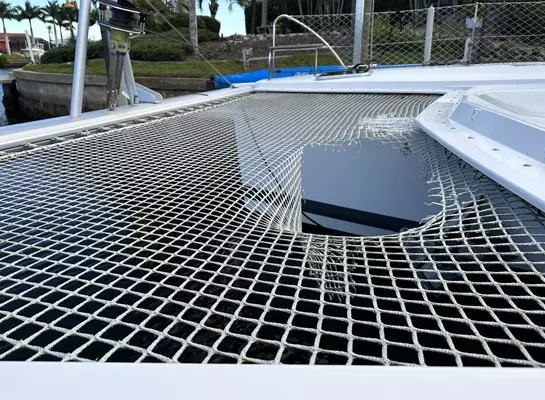
This is what it looks like when
someone goes through the net.
Don't let it happen to you.
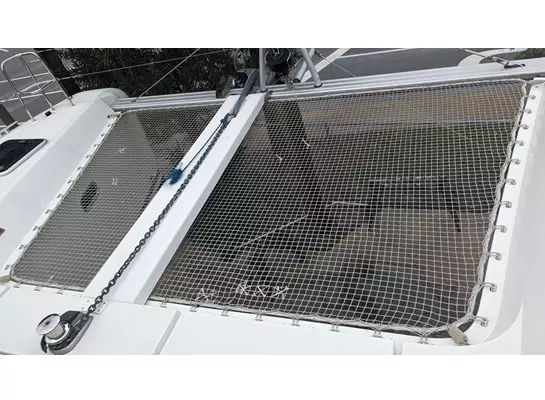
5 Year Old OEM Lagoon
Nets. These should have been
replaced at least a year prior.
The Incidents Nobody Talks About
Charles Kanter, an AMS-certified marine surveyor with over 20 years specializing in multihulls,
puts it bluntly: "There are simply too many people falling through trampolines not to bring up this vital safety issue." He should know, he fell through one himself during a delivery in Marsh Harbor,
Bahamas, describing it as "a serious accident."
Kanter isn't alone. The owners of a St. Francis 50 discovered their trampoline
had degraded so badly that two people had already fallen through before they replaced it. A Caribbean cruiser on
Cruisers Forum reported putting their foot through their
six year old nylon nets multiple times before finally upgrading to Dyneema. The consequences can be fatal. In 1983, renowned British sailor Rob James, author of Multihulls Offshore and winner of
the Round Britain Race, died at age 36 when
the safety netting on his
trimaran "gave way under his weight" and deposited him into the icy water of Salcombe Harbour. His crew couldn't turn the engineless boat back in time. Even competitors acknowledge the problem.
LOFTNETS states their nets "are designed to last three
to seven years on average", with the most common failure being "weakening of the meshes" from sun exposure. That's a best case scenario here in the Caribbean or South Pacific as we see these more
commonly in need of replacement years 2-5. And literally as I’m writing this article (“literally” is not used in the loose sense here, I was typing when the call came in) I got a call from someone
who put their foot through the net of their 4 year old Neel trimaran.
The pattern Kanter observed after examining failed trampolines is consistent: "The MO was that the owners failed to observe any failure until there was catastrophic failure." No warning. No
gradual deterioration they could see. Just sudden, dangerous failure.
Why Your Net Is Under Constant Attack
UV radiation is the primary killer, but it doesn't work alone. In tropical sailing grounds, particularly the Caribbean, airborne dust particles (including Saharan dust that travels thousands of
miles across the Atlantic) settle into your netting material. These particles act as microscopic razor blades, cutting into fibers and creating tiny entry points that expose the underlying material
to accelerated UV damage.
This creates a compound degradation effect: dust cuts the fibers, UV breaks down the exposed material, more fiber surface gets exposed, more UV damage accumulates. A net that might last 7 years
in temperate waters can be structurally compromised in 3-4 years in the tropics creating a silent risk when walking or working on the net.
Typical OEM nets and budget replacements use thin spray coatings (at best) that provide minimal protection against this dual assault. Charter boats sailing popular
Lagoon and
Leopard catamarans in the Caribbean often need replacement every 3-4 years.
The problem is that owners can't see the strength loss happening. A 5 year old net in the tropics might look like it has some life left while having lost the majority of its original tensile strength.
Why No Other Netting Company Talks About This
Search for information about catastrophic net failure and you'll find almost nothing from trampoline manufacturers. This isn't an accident.
For most netting companies, this is an uncomfortable conversation they'd rather not have. Discussing how nets fail means acknowledging that the materials and coatings they use don't adequately
protect against it. It means admitting that their 3-5 year product lifespan isn't a feature, it's a limitation they've accepted rather than engineered around. Without the data or the solution, silence
is easier than open discussion.
We talk about it because we've spent 38 years solving it. We have the UV degradation data. We have the material science. We have nets
still in service after 15 & 20 years that owners could replace for cosmetic reasons but don't need to replace for safety reasons. When
Practical Sailor, an independent, ad-free publication known for
unbiased testing, reviewed trampoline options, they specifically recommended our UV coating and noted it "can help a net last decades."
That's not marketing. That's engineering. We only market to help our customers understand the benefits they can gain with us because it can be a rather obscure subject.
What Makes the Difference
Our proprietary UV protective coating does two things that prevent catastrophic failure. First, it dramatically slows UV degradation of the underlying fibers, maintaining tensile strength for 12+
years instead of 3-5. Second (and this is often overlooked) it creates a sealed surface that prevents dust and particulates from working into the fiber structure. No microscopic cuts means no accelerated
degradation pathway.
The result is nets that stay structurally sound so long that normal cosmetic aging, fading, minor edge wear, and the inevitable signs of years in tropical sun will naturally prompt replacement long before
structural integrity is ever in question. Your net tells you when it's time through appearance, not through failure.
This is why we can offer the industry's World’s Best Tensioned Netting Warranty. It's why verified owners on
Cruisers Forum report nets "still looking great with no signs of wear" after years of
use. It's why one sailor on TheBeachcats reported his Sunrise trampoline lasting 15 years of
year round outdoor storage while supporting his 245 pound frame for mast stepping. We've engineered out the failure modes that other manufacturers accept as inevitable.
How to Inspect Your Catamaran Trampoline Net
If your current trampoline net is more than 2 years old and has spent significant time in tropical or subtropical conditions, it's worth a serious inspection. Look for:
- A chalky, dull appearance — indicates UV surface damage
- Material that feels stiff or crunchy — rather than supple
- Any softness or excessive give — when you walk on it
- Visible thread degradation — at seams and borders
- Fading that's uneven — between protected and exposed areas
- And of course, any holes or obvious damage
If you're seeing these signs, your net may be approaching the danger zone, even if it looks structurally intact. The research is clear, owners consistently fail to identify failing nets
until catastrophic failure occurs or, all too often, they know the net needs replacement and put it off longer than they should. Remember, if you get a Sunrise Net it’s a pain today, but
something you can not spend time thinking about for the next decade +.
We have a number of helpful resources on our website if you’d like to learn more. For the technical data on how UV degradation affects netting materials, see our
UV Resistance Data. Our comprehensive Netting White Paper covers
all factors affecting net longevity and safety and is a great starting spot if you like engineering or to know all the details about something, or start with the
Executive Summary for key points.
Upgrade to Nets Engineered for a Decade+ of Safe Service
When you're ready for nets engineered to last decades, explore our catamaran net options, we have patterns
for virtually every Lagoon, Leopard, Fountaine Pajot, and other major manufacturer on file. Check out our gallery to see examples
across hundreds of installations, and review our warranty to understand why we can stand behind our products longer than anyone else
in the industry.
Your trampoline represents 25-35% of your usable deck space. It's where you relax at anchor, handle lines underway, and move between hulls. It shouldn't be the thing you're quietly worried
about every time you step onto it.
Make today the last time you ever have to think about it.
Regards,
Matt, Mike, & Caleb
Sunrise Yacht Products
The World's Most Durable Catamaran Nets™